


The Ingredients

Betula Neoalaskana
Paper BirchHere are some reasons we LOVE our birch trees!
When the huge glaciers of the last ice age receded, birch trees would have been one of the first to re-colonise the rocky, ice-scoured landscape.
Hence, ecologists refer to birch as a pioneer species. In Celtic and other indigenous cultures, the birch tree symbolizes renewal, light, and new beginnings - a tree that marks fresh starts and gentle transformation. As one of the first trees to grow after disturbance or hardship, birch has long been associated with hope, cleansing, and the quiet return of life.
The word ‘birch’ is believed to stem from the word ‘bhurga’ – a Sanskrit word meaning ‘tree whose bark is used to write upon’.
We know that the king of Rome in the 7th-8th century BC, Numa Pompilius, is said to have had his own birch-bark books buried with him in his grave, so showing how even at this early date, the bark of the birch was highly prized for book making. This connection reinforces birch tree symbolism as a tree of learning, insight, and communication.
In the Celtic world, birch trees are also associated with the Northern Lights, the Aurora Borealis.
In Wales, a man would present the woman he loved with a garland of birch to show his feelings – and would know that she shared his feelings if she gave him one back, and a newly married couple would step over abirch broom to enter their new home together, representing a wish for fertility. Celtic women are thought to have traditionally used birch to ask God for assistance in childbirth (a time of new beginnings).
Cool right?!
Now what about actual benefits..
Birch trees (leaves, bark, and sap) offer significant health benefits, acting primarily as a natural diuretic and anti-inflammatory agent to support urinary tract health, reduce joint pain, and aid detoxification. Rich in antioxidants like Vitamin C and flavonoids, birch helps treat skin conditions, lowers cholesterol, and supports cardiovascular health.
• Urinary Tract and Kidney Support:
• Birch leaf extracts act as a powerful diuretic, increasing urine production to help flush out kidney stones, bladder stones, and toxins. It is used to relieve edema (water retention) and cystitis.
• Anti-inflammatory and Joint Health: The bark contains betulin and salicylate compounds (natural precursors to aspirin), which help reduce joint inflammation, arthritis, and rheumatic pain.
• Skin Health and Healing: Birch extract is used to treat skin conditions like acne, eczema, and psoriasis due to its astringent and detoxifying properties. Its high betulin content also aids in accelerating wound healing.
• Cardiovascular and Metabolic Health: Birch helps lower high cholesterol, and the sap contains saponins, which may help improve fat metabolism.
• Nutritional Boost: Birch sap is a nutrient-rich water packed with minerals and antioxidants. It is used as a tonic to boost immunity, especially after winter (spring cure).
• Oral Health: Birch sap contains xylitol, which can help reduce tooth decay by preventing bacteria from adhering to teeth.
• Birch Water/Sap: A refreshing drink that supports detoxification and provides nutrients.
• Birch Tea: Made from leaves, often used for kidney flushing and as a diuretic.
• Tinctures and Creams: Applied topically for joint pain or skin issues.
Nordic people have drunk birch water for thousands of years, making birch beer, kvass (a fermented beverage made using rye bread and birch syrup as a sugar) and syrup (Adamant, 2018).
So, what are the health benefits of drinking birch water? It’s low in calories and sugar and 300ml contains 95% of your daily value of magnesium and 130% of your daily manganese (McGrane, 2019).
When combined with calcium, zinc and copper, that are all found in birch water, manganese can reduce spinal bone loss in older women (McGrance, 2019). Manganese is required for normal functioning of your brain and nervous system and can improve bone health as bone mineral density is supported (Goodson, 2018). Its antioxidant properties help combat high cholesterol and arthritis (Goodson, 2018).
Magnesium is an essential nutrient for energy, protein formation, muscle contraction and relaxation and nervous system regulation (Spritzler, 2018). As around 50% of people in the US and Europe don’t get enough magnesium (Spritzler, 2018), birch water has an important role to play in ensuring this mineral is in your diet.
But that’s not all. Birch water also contains polyphenol antioxidants that fight oxidative stress, an imbalance of free radicals in the body that easily react with other molecules. Polyphenols work as a preventive for heart disease, Type II diabetes, osteoperosis, Alzheimer’s, Parkinson’s and some cancers (McGrane, 2018).
And birch water is also a source of Vitamin C, an antioxidant that stimulates collagen production and protects the body from UV rays. Sailors historically drank birch water to ward off scurvy, a Vitamin C deficiency that causes weakness, bleeding from the skin and gum disease (McGrane, 2018).
And what’s more, birch water can also aid in weight loss as it eliminates excess salt and cleanses the urinary tract of harmful toxins (Patterson, 2016). When toxins build up, the body holds onto fat to protect your organs. Removing toxins helps the liver as it doesn’t have to work so hard to remove toxins from the body.
Birch water also contains xylitol, a natural chemical compound that can reduce tooth decay. It coats the teeth and the bacteria that cause tooth decay can’t feed on it (Patterson, 2016).
But to get the full benefits of birch water, you need to drink it in moderation to keep a healthy balance. Drinking too much birch water will create an excess of manganese in your diet and so you should limit your intake of birch water (McGrane, 2019). An excess of manganese (typically more than 11mg per day by mouth) can cause tremors, difficulty walking, aggression and hallucinations (Reuters, 2001).
Trees of the Betula genus create sap that is harvested in early spring (McGrane, 2019).
**All of our birch products are harvested and processed ourselves, and product is limited due to it being a short seasonal harvest window. What we obtain by the middle of may is what we have in stock until April the following year. So don’t wait!

Fireweed
Chamaenerion Angustifolium
Fireweed is a perennial herbaceous flowering plant in the willowherb family, Onagraceae. It is known in North America as fireweed and in the British Isles as both fireweed and rosebay willowherb. It is also known by the taxonomic synonymsChamerion angustifolium and Epilobium angustifolium. It is native throughout the temperate Northern Hemisphere, including large parts of the boreal forests.
The generic name Chamaenerion means "dwarf rosebay" in allusion to the outward similarity to rosebay, Nerium oleander, while the specific epithet angustifolium means "narrow-leaved". It is commonly known in Britain as "rosebay willowherb", for the same reason. The common American name "fireweed" derives from the species' abundance as a colonizer on burnt sites after forest fires and other disturbances.
Fireweed is an effective colonizer; it may not be present until after a fire has moved through a landscape. Because of its very high dispersal capacity, "propagule pressure" from its regional presence will let it quickly colonize a disturbed area. Once seedlings are established, the plant quickly reproduces and covers the disturbed area via seeds and rhizomes. It is somewhat adapted to fire as well and so can prevent the reintroduction of fire to the landscape. Fireweed is well adapted to seed in severely burned areas as well, because the mineral soil that is exposed due to the removal of organic soil layers provides a good seedbed.
In Britain the plant was considered a rare species in the 18th century, and one confined to a few locations with damp, gravelly soils. It was misidentified as great hairy willowherb in contemporary floras. The plant's rise from local rarity to widespread abundance seems to have occurred at the same time as the expansion of the railway network and the associated soil disturbance. The plant became locally known as 'bombweed' due to its rapid colonization of bomb craters during World War II.
Bears and elk are known to favor the plant as food.
Traditionally the young shoots are collected in the spring by Native American and Siberian people and mixed with other greens. As the plant matures, the leaves become tough and somewhat bitter. Fireweed petals are made into jelly, and mature leaves are dried for use as tea. When properly prepared soon after picking they are a good source of vitamin C and provitamin A. The Denaʼina add fireweed to their dogs' food. In Russia, fireweed is made into a tea known as Ivan-Chai (Ivan-Tea) or Koporsky tea (from the town of Koporye, where it has been produced since the 13th century). They use it as highly prized medicinal herb too. Fireweed tea is high in iron, copper, potassium and calcium.
Fireweed is also a medicine of the Upper Inlet Dena'ina, who treat boils or cuts by placing a piece of the raw stem on the afflicted area. This is said to draw the infection out and prevents it from healing over too quickly. The Nlaka'pamux use the blooming of fireweed as a temporal indicator that mule deer have just given birth, meaning it is a good time to hunt for them.
The honey produced from fireweed is highly valued for its quality. Most fireweed honey is produced in locations in cool climates, such as the Pacific Northwest in the United States and Scandinavian countries in Europe.
Because fireweed can colonize disturbed sites, even following an old oil spill, it is often used to re-establish vegetation.
**All of our fireweed products are harvested and processed ourselves, and product is limited due to it being a short seasonal harvest window. What we obtain by the end of September is what we have in stock until August the following year. So don’t wait!
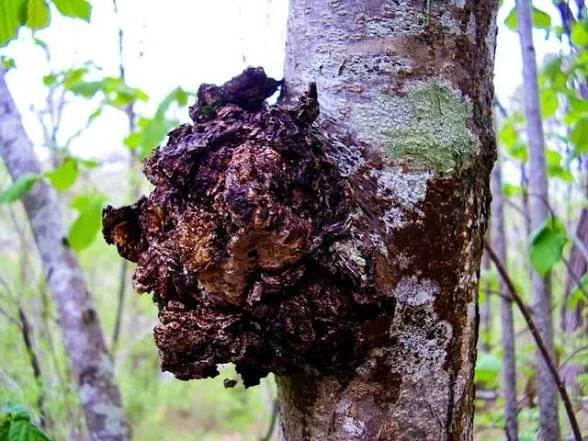
ChagaInonotus obliquus
Foraged from the very birch trees we brag about, chaga is a fungus that grows along the outside of infected trees. This black gold is packed dense with benefits. Think all the same benefits from the birch but condensed. Its like the chaga sucks out all the nutrients and medicinal properties into one point.
Long utilized by native populations for its various healthful properties, Inonotus obliquus, or chaga, is a mass of mycelium or sclerotium resembling burnt charcoal. The sterile conk grows primarily on birch trees and other hardwoods in forests throughout the northern hemisphere. Our organic chaga mushrooms can be decocted into chaga tea and incorporated into broths and soups. Chaga is rich in antioxidants and compounds like polysaccharides, polyphenols, and triterpenes, which are studied for potential immune-boosting, anti-inflammatory, and anti-cancer effects, though they say studies are limited. It's important to note the high oxalate content and potential interactions with medications warrant caution.
The antioxidant activity of polysaccharides (beta-glucans) contained in chaga help maintain cell integrity and fight free radicals. Chaga is used in traditional Russian Folk Medicine and Traditional Chinese Medicine to support gastrointestinal health, and as a tonic to support overall health.
Chaga is a fungus, a parasitic carpophore that looks like the charred remains of burned wood on the side of a birch tree (sometimes growing on Elm and Alder, but Birch is its favorite). Birch is also the only known safe tree to harvest Chaga from. It is not the fruiting body of the fungus, but a sclerotia or mass of mycelium. The parasite enters the tree through a 'wound' in the bark of a mature tree. It then grows under the bark until it erupts in a deeply cracked, black charcoal like extension. It usually takes another 5-7 years for it to fully mature, at which point it falls to the forest floor, most times killing the host tree in the process. Chaga has been a part of folk medicine in Russia, Poland, China and numerous Baltic countries for many centuries. It was documented by Chinese herbalist Shen Nong in his herbal texts as early as the first century B.C.E.
Chaga supports immune health to help you stay feeling your best and supports the body’s immune defenses to stay feeling healthy.
Chaga is typically and historically ingested as a tea, but it also has been made into a tincture, and less commonly into powder that is then used as a tea; Encapsulation seems to be rare. There have been reports of it being the base for liqueurs and as a substitute for hops in beer. In Russia, it can be found as a syrup, a tablet, an aerosol, and even as a suppository. If you are using the cut chaga for the purpose of making a tea, you can re-brew your material a second time without loss to flavor or potency. Our chaga includes the sclerotia.
Chaga is rich with powerful antioxidant compounds. An antioxidant compound absorbs the harmful by products of cellular metabolism which cause cell damage and speed aging. These compounds are found in the polyphenols, enzymes, and pigments (like melanin) that produce as they grow. In addition, chaga has high levels of minerals like copper, selenium, zinc and manganese which promote the body’s own response to free radicals.
Antioxidant levels are measured in an ORAC score (Oxygen Radical Absorbency Capacity) – a “high antioxidant” food usually has an ORAC score of around 25,000/100g. Most producers report ORAC values around 150,000/100g – sourcing matters!
This score indicates an exceptionally high antioxidant capacity, over 50 times higher than blueberries, and is used to measure its ability to neutralize free radicals and reduce oxidative stress in the body! The high value is due to a high concentration of melanin and polyphenols.
Chaga has very high concentrations of polysaccharides with therapeutic properties. One of the best studied is beta-glucans, a well-established immune-modulator which helps the immune system respond quickly and effectively, enabling your body to better fight stress and pollution, and decreasing the side effects of chemotherapy and other aggressive medication. Turkey Tail contains polysaccharide-K (PSK) and polysaccharide-P (PSP), which have been shown to antimetastatic cancer-fighting effects.
️Chaga contains the compounds betulin and betulinic acid, terpenes that have anti-viral effects (including anti-HIV), as well as cholesterol-lowering properties. These compounds derive from the chaga organism’s symbiotic growth on birch trees in the wild, so any farmed industrially produced chaga will not contain these compounds (one important reason why we are so careful and only source wild chaga ourselves). Chaga also contains phytosterols with powerful anti-viral and potential anti-cancer effects, such as inotodiol, lanosterol, ergosterol, and fecosterol.